Scheduling Rules: The Secret to Fair, Compliant, and Chaos-Free Rotas
Ask any operations manager what makes scheduling difficult, and you’ll rarely hear “technology” as the first answer.
The real challenge lies in balancing laws, policies, preferences, and personalities. A rota may look simple on paper, but underneath it sits a web of rules that determine whether it works in practice.
Why Rules Matter
Every organisation operates within a framework of constraints. Labour laws dictate rest periods and overtime limits. Company policies define fairness, rotation, and seniority. Managers have operational insights that can’t always be written into a spreadsheet. When these rules are ignored or applied inconsistently, the outcome is chaos: understaffed shifts, employee frustration, and, at times, legal exposure.
Rules aren’t a burden; they are the structure that allows flexibility. The more accurately they’re defined and enforced, the smoother scheduling becomes.
The Limits of Manual Oversight
Many scheduling tools rely heavily on human oversight. They can flag a conflict, but they can’t always prevent it. This means managers are still left checking every detail - who worked last weekend, who needs a rest period, who is over their contracted hours. These manual checks are slow, error-prone, and unsustainable at scale.
The result is what many managers quietly admit: the rota only works because they spend hours fixing it after the system has done its part.
How Rule-Based Scheduling Changes the Game
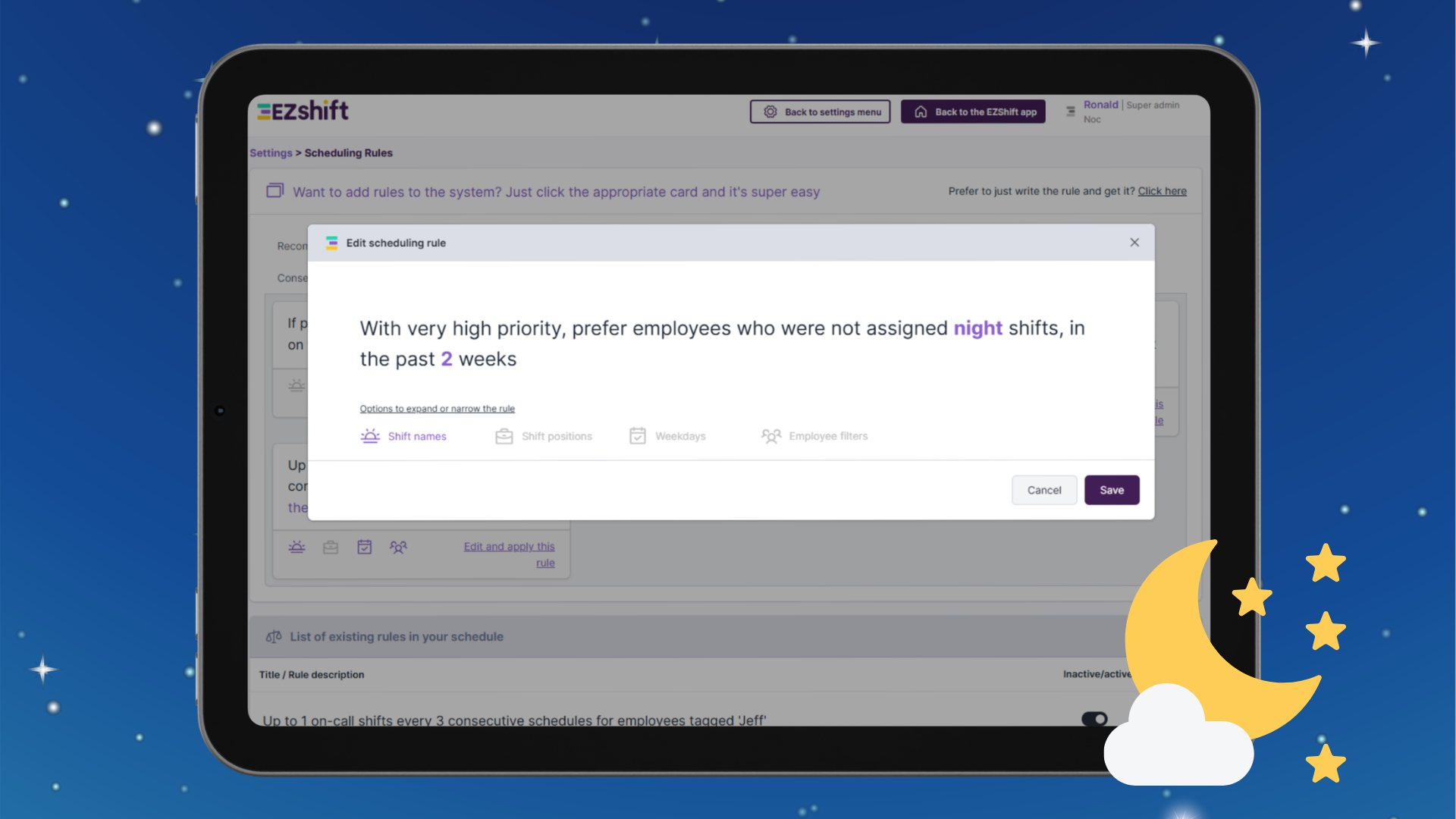
A truly rule-based system approaches scheduling differently. Instead of asking managers to react to problems, it prevents them from occurring in the first place. Each organisation defines its own set of parameters - legal,operational, and personal, and the scheduling engine ensures every shift complies with them automatically. For example, you can ensure that no employee works a morning shift right after a night shift, that difficult duties are rotated fairly, or that specific roles always appear together on critical shifts. The system check sthousands of combinations in seconds, guaranteeing the final rota meets every requirement without compromise.
Balancing Precision with Flexibility
The most advanced systems recognise that not all rules are equal. Some are absolute, such as legal rest periods; others are guiding principles, like preferred working days. A good scheduler distinguishes between these layers, strictly enforcing the hard rules while using the softer ones to make balanced, human decisions. This balance is particularly valuable in industries facing staff shortages. When flexibility is needed, the system adapts intelligently without breaking compliance.

From Policy to Practice
Rule-based automation transforms scheduling from a negotiation into a process of certainty. Managers can trust that every rota is fair and compliant before it reaches the team. Employees, in turn, see a transparent, predictable pattern that feels equitable and professional. Over time, this consistency builds trust, and trust builds retention. Behind the scenes, systems like EZShift have been designed precisely around this principle: allowing organisations to define their own logic and letting the engine handle the rest. Managers still make decisions; they just make them faster, with better information and fewer conflicts.
The Bottom Line
Scheduling rules are not bureaucracy; they are the language of fairness, efficiency, and compliance. When a system truly understands and applies them, it eliminates friction between policy and people.
That’s how complex operations stay organised, lawful, and calm, even when everything else is changing.